Geopolitical shocks grab headlines.
Smart investors look past them.
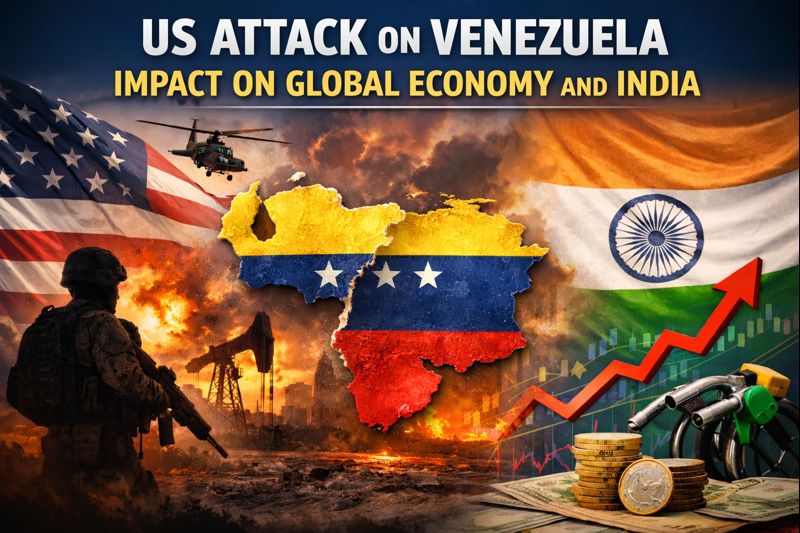
The recent US military action against Venezuela has triggered fears around oil prices, inflation, and global instability. Social media is already full of extreme takes — from “oil will explode” to “markets will crash.”
Let’s slow this down and analyze what actually matters — especially for India and Indian investors if Indian Investors should worry about the the US Venezuela conflict
Why Venezuela Matters (At Least on Paper)
Venezuela sits on one of the largest oil reserves in the world. Any military or political disruption involving an oil-rich nation naturally raises concerns about:
- Global oil supply
- Energy prices
- Inflation
- Market volatility
However, markets don’t react to headlines — they react to actual supply disruption.
So the key question is not “Was there an attack?”
It is “Will global oil supply meaningfully reduce?”
As of now, that answer is uncertain — and likely limited.
The Real Global Impact: Risk Premium, Not Collapse
In most geopolitical conflicts, the first reaction is fear, not fundamentals.
What usually happens:
- Oil prices rise temporarily due to risk premium
- Gold moves up as a short-term safe haven
- Equity markets turn volatile for a few sessions
What usually does not happen:
- Long-term supply collapse
- Sustained global recession
- Permanent market damage
Unless the conflict spreads or disrupts major shipping routes, global economic impact tends to be short-lived.
Markets adapt faster than headlines suggest.
What This Means for India (The Important Part)
1. India’s Direct Exposure Is Low
India no longer depends heavily on Venezuelan oil. Our crude imports are diversified across multiple countries.
This means:
- No immediate supply shock
- No direct trade disruption
- No Venezuela-specific economic risk
2. Oil Prices Are the Only Real Transmission Channel
India does import most of its oil — so global price movements matter.
If oil prices rise sharply and stay elevated:
- Inflation can inch up
- Fuel prices may come under pressure
- The rupee could weaken marginally
- Government finances may tighten
But for this to become a serious issue, oil prices need to remain high for months, not days.
So far, markets are pricing uncertainty, not disaster.
How Should Indian Investors React? (Short Answer: Don’t)
This is where most investors go wrong.
They:
- Panic sell equities
- Chase gold after it has already moved
- Freeze SIPs waiting for “clarity”
That’s the opposite of rational investing.
A few grounding truths:
- Indian equity markets are driven by earnings, growth, and liquidity
- One geopolitical event does not change long-term India growth
- SIPs exist precisely to handle volatility
- Time in the market beats reacting to news
If your portfolio is diversified and goal-based, you do nothing.
Asset-by-Asset View (Quick Take)
- Equities: Short-term volatility possible, long-term story unchanged
- Debt: No immediate impact unless inflation spikes meaningfully
- Gold: May rise temporarily; not a reason to chase
- INR: Minor pressure possible if oil spikes, not a crisis
This is noise, not a trend — unless proven otherwise.
The Base Investor Takeaway
Geopolitical events test investor temperament, not portfolio construction.
The biggest risk right now is not the US or Venezuela.
It’s emotional decision-making.
If your investments are:
- Long-term
- Diversified
- Aligned with your goals
Then this event changes nothing for you.
And if an event like this makes you anxious, the answer isn’t changing your investments —
It’s strengthening your investment framework.
Final Thought
Markets reward patience.
News rewards panic.
Choose wisely.
— The Base Investor